Abstract
A 72 year old male has been seeking medical attention for 3 months due to intermittent palpitations and shortness of breath, with no significant changes in the past 3 months. He has taken propafenone and metoprolol tartrate, but his symptoms have not improved.
INTRODUCTION
A 72 year old male has been seeking medical attention for 3 months due to intermittent palpitations and shortness of breath, with no significant changes in the past 3 months. He has taken propafenone and metoprolol tartrate, but his symptoms have not improved. It is clear that there is no correlation with activity, sleep, full meal, cold, etc. The onset is irregular and his diet, bowel movements, and sleep are normal. Having a history of cerebral infarction and lower limb arterial occlusive disease for many years, the patient regularly takes Aspirin and Rosuvastatin. The patient denies having a history of sleep respiratory syndrome. During the initial visit, holter showed a total of 28666 atrial premature in 23 hours and 19 minutes (Figure 1 A1).
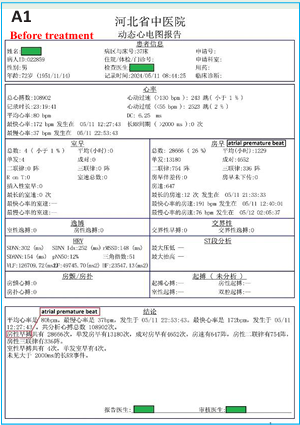
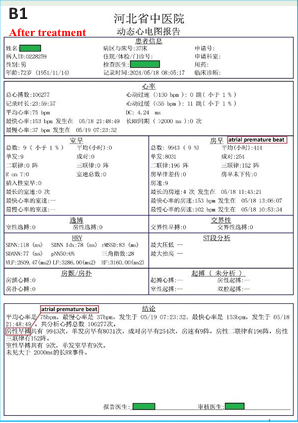
Figure 1: The results of Holter before and after Chinese Medicine treatment
The patient requested Chinese Medicine treatment. Based on the patient’s condition and Traditional Chinese Medicine theory, doctor applied Chinese Medicine belonging to Yang for 7 days. Holetr showed a total of 9943 atrial premature in 23 hours and 59 minutes (Figure 1 B1) after the treatment. The patient’s palpitations and shortness of breath symptoms were significantly reduced and the treatment effect was satisfactory.
A careful observation of the patient’s first holter shows that the number of the atrial premature during the day (Figure 1 A2) is significantly higher than the night (Figure 1 B2) before treatment.
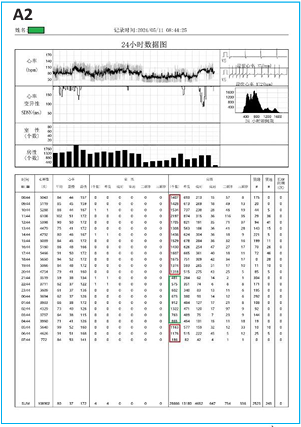
The results of Holter before and after Chinese Medicine treatment
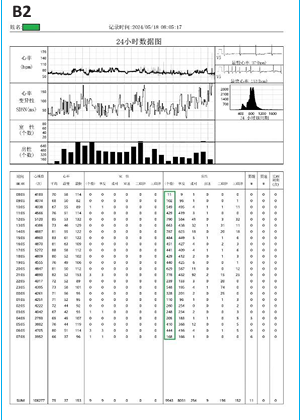
According to modern Pathophysiology, this may be due to the patient’s activity, sympathetic nervous system excitation, and faster average heart rate during the day, which leads to insufficient blood supply to the heart, result in an increase in atrial premature. At night during sleep, the patient’s relaxation, parasympathetic nervous system excitation, and slower average heart rate, improve blood supply to the heart and reduce atrial premature beats compared to the day. Considering the above situation, the use of beta blockers may be more effective [1]. But the patient showed poor efficacy after using beta blockers, so the patient request treatment with Chinese Medicine. In the physiological system of Traditional Chinese Medicine, “Yin-Yang” theory is a very important concept. They are two unitied and opposites aspects of everything and anything can be divided into “Yin” and “Yang”. If the human body is classified according to “Yin-Yang” theory, the activity, sympathetic nervous system excitation, increased heart rate, and body surface belong to Yang. While rest, parasympathetic nervous system excitation, decreased heart rate, and visceral organs belong to Yin [2]. In a day, the day belongs to Yang and the night belongs to Yin.
According to this theory, patients with more atrial premature during the day and less at night may be caused by an imbalance of Yin and Yang. Traditional Chinese Medicine believes that the amount of Yin and Yang in the human body is equal under physiological conditions. During the day, the Yang travels on the body surface, promotes body activity, excites sympathetic nerves, and increases heart rate [3]. At this time, the Yang in the visceral heart is relatively insufficient in this patient. At night, the Yang travels on the internal organs, excites the parasympathetic nerves, and slows down the heart rate. The body surface is relatively deficient in Yang, but the Yang in the visceral heart is relatively sufficient. This is the explanation of Traditional Chinese Medicine for this patient with more atrial premature during the day and less at night. In another way, the Yang in the heart is insufficient. Coincidentally, Traditional Chinese Medicine also clearly distinguishes Chinese Medicine through Yin-Yang theory. The application of Chinese Medicine Belonging to Yang that increases cardiac Yang significantly reduces atrial premature in patients. The diagnosis and treatment system of Traditional Chinese Medicine is not as simple as mentioned above. It involves many concepts. But in this patient, the main theory applied in the treatment process is the Yin-Yang theory and the effect is obvious. This case can explain the process of diagnose and treatment when it uses the Yin-Yang theory of Traditional Chinese Medicine. It conforms to materialist dialectics. This can help clinical doctors understand the treatment ideas of Traditional Chinese Medicine.
How to Cite
References
URL: https://pubmed.ncbi.nlm.nih.gov/29438514/
URL: https://pubmed.ncbi.nlm.nih.gov/38317142/
URL: https://pubmed.ncbi.nlm.nih.gov/33433846/